Abstract
This paper presents a speculative but internally consistent framework in which the human nervous system is treated as a coherent electromagnetic interferometer capable of producing structured field effects external to the body. The model does not assert new physics, forces, or experimentally verified phenomena. Instead, it reframes established principles of wave interference, neural synchronization, electromagnetic potentials, and control theory to describe how a personal-scale protective boundary—informally termed a “Tesla Shield”—would be modeled if it were physically realizable.
Scalar and longitudinal field concepts are treated as structured electromagnetic potentials rather than exotic propagating waves. Astral projection and anomalous cognition are incorporated phenomenologically as altered reference-frame states arising from extreme neural coherence. The objective is conceptual translation, not validation.
1. Introduction
Human culture has long entertained the idea that consciousness can directly influence physical reality. Across civilizations and historical periods, recurring metaphors and practices suggest that altered or highly ordered mental states are associated—at least phenomenologically—with anomalous physical or perceptual effects. Ancient yogic traditions describe prāṇa as a subtle organizing principle underlying biological vitality and external influence. Esoteric Western traditions invoke will, intention, and focused imagination as causal agents. In more contemporary contexts, manifestation practices, psychokinesis claims, and astral projection narratives persist despite the absence of controlled experimental validation.
What unifies these traditions is not a shared mechanism, but a shared pattern: the assertion that coherent mind states—rather than ordinary waking cognition—are prerequisite for anomalous outcomes. Disorganized, distracted, or emotionally noisy mental activity is universally regarded as ineffective, while disciplined attention, sustained visualization, rhythmic repetition, and emotional alignment are treated as necessary conditions. This consistency suggests that the operative variable, if any exists at all, is not belief or symbolism, but coherence.
Modern neuroscience provides a partial bridge between these cultural observations and measurable physical processes. Neural activity is fundamentally electrical, mediated by ionic currents, synchronized oscillations, and large-scale electromagnetic field patterns. Under ordinary conditions, these fields are weak, noisy, and rapidly decohering, producing no detectable influence beyond the skull. However, under specific conditions such as deep meditation, trance states, or focused attentional absorption, neural dynamics exhibit increased phase synchronization, reduced entropy, and large-scale coherence across cortical regions.
This paper formalizes one speculative interpretation of these observations: that the brain, under extreme coherence conditions, could be modeled as a biological interferometer. In classical physics, an interferometer is not defined by its power output, but by its ability to maintain phase stability between two or more coherent sources. Small amplitudes can produce structured spatial patterns when coherence is preserved. The analogy proposed here is not that the brain generates large energies, but that it may—hypothetically—generate structured information within its electromagnetic activity.
Inspired by speculative interpretations of Nikola Tesla’s remarks on non-Hertzian waves, this framework explores whether neural electromagnetic activity could, in principle, produce longitudinal potential modulations rather than radiative transverse fields. In orthodox electromagnetism, scalar and vector potentials are mathematical tools whose derivatives yield observable electric and magnetic fields. However, in near-field regimes, confined geometries, and gauge-dependent formulations, these potentials can exhibit structure without corresponding far-field radiation.
Within this interpretive space, “scalar” effects are not treated as new particles or propagating waves, but as organized potential configurations—patterns of phase, timing, and geometry embedded within existing electromagnetic degrees of freedom. If such organization could be maintained coherently, interference effects could arise not from energy transfer, but from phase relationships.
Under the most speculative interpretation of this model, extreme neural coherence could allow bilateral brain activity—particularly between the two hemispheres—to function analogously to the arms of an interferometer. Constructive interference of structured potentials could, in theory, generate a stable spatial pattern external to the body. The commonly described “protective dome” or “wall of force” is modeled here not as a material barrier, but as a standing interference condition—a hemispherical boundary defined by coherence rather than mass or force.
It is critical to emphasize that this framework does not claim feasibility, experimental support, or known biological capability. The magnitudes involved in neural electromagnetic activity are many orders of magnitude below those typically required for macroscopic field effects. No known mechanism allows biological systems to project stable electromagnetic structures at a distance under laboratory conditions.
Accordingly, this work is framed explicitly as a mapping exercise, not a technological proposal. The question is not whether such a shield exists, but rather: if it did exist, what aspects of established physics would it most closely resemble? Would it resemble force fields, spacetime curvature, plasma confinement, wave interference, control systems, or information-theoretic structures?
By constraining the discussion to known physical formalisms—wave mechanics, electromagnetism, coherence theory, and feedback control—this framework aims to translate esoteric language into falsifiable, technically interpretable models. In doing so, it separates metaphor from mechanism while preserving the conceptual structure that has persisted across centuries of human speculation.
The sections that follow progressively refine this translation, beginning with the reinterpretation of scalar phenomena, then examining neural coherence as an interferometric process, and ultimately situating astral projection and protective-field narratives within the limits imposed by contemporary physics.
2. Scalar Waves as a Reinterpretation of Known Physics
In orthodox electromagnetic theory, all observable electromagnetic phenomena are described by Maxwell’s equations, which predict transverse wave propagation in free space. Electric and magnetic fields oscillate perpendicular to the direction of energy transport, and no freely propagating longitudinal electromagnetic waves exist in vacuum under standard conditions. This framework does not dispute that conclusion.
However, Maxwell’s equations are not written directly in terms of electric and magnetic fields, but in terms of scalar and vector potentials from which those fields are derived. The scalar potential and vector potential together encode the full electromagnetic state, while the observable fields arise from spatial and temporal derivatives of those potentials. As a result, the potentials themselves possess mathematical degrees of freedom that do not always correspond to radiative field components.
In conventional engineering practice, these potential-based degrees of freedom are often treated as gauge artifacts—useful for calculation, but not physically independent. Yet in certain regimes, particularly near-field zones, confined geometries, resonant structures, and plasma environments, potential structure becomes operationally relevant. Energy may be stored, phased, and redistributed locally without producing far-field radiation.
Within this context, so-called “scalar waves” are reinterpreted here not as novel propagating entities, but as structured modulations of electromagnetic potentials that remain spatially bound. These modulations may encode phase information, geometric constraints, or interference conditions without corresponding energy transport. They are therefore non-radiative and non-Hertzian by definition.
This reinterpretation resolves a common category error found in scalar-wave claims: the assumption that scalar phenomena must behave like transverse radiation. In reality, near-field electromagnetic behavior already exhibits longitudinal components, reactive energy storage, and geometry-dependent field structure. These effects decay rapidly with distance and do not violate established conservation laws.
From this perspective, scalar phenomena are not exotic additions to physics, but descriptions of underemphasized regimes within existing theory. Longitudinal electric fields arise naturally in plasmas, waveguides, capacitive systems, and standing wave configurations. In each case, geometry and boundary conditions—not energy magnitude—determine behavior.
Tesla’s historical references to non-Hertzian waves are interpreted here conservatively as intuitive descriptions of such non-radiative regimes rather than evidence of unknown forces. While later authors extrapolated these ideas into claims of superluminal communication or unlimited energy transfer, no experimental support exists for those interpretations. This framework explicitly rejects such extrapolations.
Instead, the value of scalar concepts lies in their emphasis on phase, resonance, and geometry. A system may exhibit significant internal structure while remaining externally invisible to conventional field detection. Energy circulates locally, interference patterns form, and reactive fields dominate behavior without emitting radiation.
Applied to the neuro-scalar interferometric model, this suggests a constrained hypothesis: if neural electromagnetic activity could achieve extreme coherence and geometric organization, it might hypothetically produce structured potential configurations in the immediate near-field surrounding the body. These configurations would not propagate outward, radiate energy, or register as classical electromagnetic signals.
Such effects, if they existed, would therefore be subtle, localized, and information-rich rather than energetic. They would manifest not as detectable fields, but as altered boundary conditions influencing how external perturbations couple to the individual’s near-field environment.
It is essential to reiterate that no experimental evidence demonstrates biological generation of structured electromagnetic potentials beyond the skull. The neural electromagnetic fields measured by EEG and MEG are weak and rapidly attenuating. This section does not argue otherwise.
Rather, the scalar-wave reinterpretation serves a conceptual purpose: it identifies the only plausible theoretical niche in which mind–field interaction narratives could be discussed without invoking violations of Maxwellian electrodynamics. That niche lies in coherence, geometry, and near-field organization—not force generation or radiation.
The next section builds on this reinterpretation by examining how bilateral neural coherence could be modeled as an interferometric system capable of sustaining such organized potential structure, at least in theory.
3. The Brain as a Bilateral Interferometer
The human brain is anatomically divided into two hemispheres connected primarily by the corpus callosum. While popular accounts often exaggerate functional asymmetry between the hemispheres, contemporary neuroscience emphasizes their continuous interaction and dynamic synchronization. Large-scale neural activity is characterized by oscillatory behavior spanning multiple frequency bands, with coherence between distributed regions serving as a marker of functional integration.
Electroencephalography and magnetoencephalography demonstrate that neural populations can enter states of phase locking, in which oscillations across spatially separated regions maintain stable phase relationships over time. Such synchronization is not incidental; it plays a critical role in perception, attention, memory binding, and motor coordination. When coherence breaks down, cognitive fragmentation and noise increase.
Within this framework, the two cerebral hemispheres are modeled abstractly as coupled oscillatory systems rather than as isolated processors. Each hemisphere contains multiple oscillators, but under certain conditions—particularly sustained attention, meditation, or trance states—global coherence increases and hemispheric phase alignment becomes more pronounced.
In classical interferometry, an interference pattern arises when two coherent sources share a stable phase relationship. The amplitude of each source may be small, but if relative phase is preserved, spatial structure emerges through superposition. The interferometer itself does not create energy; it organizes it.
The analogy proposed here treats bilateral neural coherence as a biological analogue of this process. The left and right hemispheres act as distributed, phase-correlated sources, while neural pathways and sensory feedback loops function as coupling mechanisms that stabilize phase relationships. The relevant variable is not signal strength, but phase stability over time.
Importantly, this model does not suggest that the brain produces clean, monochromatic waves analogous to laboratory lasers. Neural oscillations are broadband, noisy, and highly complex. However, coherence does not require purity; it requires correlation. Even noisy systems can produce stable interference structure when phase relationships are constrained.
Under ordinary waking conditions, neural coherence fluctuates rapidly, preventing the formation of persistent large-scale structure. Cognitive load, emotional reactivity, and sensory distraction continuously perturb phase alignment. As a result, any potential interference effects remain transient and internally confined.
Under altered states associated with sustained focus, sensory withdrawal, or rhythmic entrainment, these perturbations are reduced. Neural entropy decreases, oscillatory modes synchronize, and bilateral phase relationships stabilize. From an interferometric perspective, the system transitions from a noisy, decohered regime to a more ordered, phase-locked one.
If one adopts the speculative assumption introduced in Section 2—that structured electromagnetic potentials could exist in near-field regimes without radiative loss—then bilateral neural coherence becomes the only plausible biological mechanism capable of generating such structure. The brain’s geometry, symmetry, and continuous feedback make it uniquely suited to interferometric modeling.
Within this interpretation, the body itself serves as a resonant cavity and boundary condition. Sensory feedback, proprioception, and autonomic regulation close the loop, providing continuous phase correction analogous to stabilization mechanisms in physical interferometers.
The relevance of this analogy lies not in claiming an effect, but in identifying constraints. Any hypothetical external field structure would require sustained bilateral coherence, continuous feedback, and geometric stability. Without these conditions, no persistent pattern could form, regardless of belief or intention.
It must be emphasized that current neuroscience provides no evidence that neural interference effects extend beyond the skull in any measurable way. The interferometer model is therefore not an empirical claim, but a formal analogy used to translate subjective reports into a language compatible with wave physics.
The next section examines how intentional cognition and sustained attention could function as biological phase-control mechanisms within this interferometric model, without invoking nonphysical agency or violations of known laws.
4. Intentional Cognition as Phase Control
In physical interferometric systems, interference patterns are governed not by absolute signal strength, but by relative phase. Small fluctuations in phase can dramatically alter spatial structure, while large increases in power produce no meaningful effect if phase relationships are unstable. Control of interference therefore reduces to control of phase.
Within the neuro-scalar interferometric model, intentional cognition is interpreted not as a causal force acting on the external world, but as a biological mechanism for stabilizing internal phase relationships. Attention, visualization, and emotional engagement function as regulatory variables that influence neural timing, synchronization, and coherence.
Cognitive neuroscience already recognizes attention as a modulatory process rather than a signal generator. Attention does not introduce new neural energy; it redistributes existing activity, suppresses competing signals, and enhances signal-to-noise ratios. From a systems perspective, attention operates as a gain-control and noise-reduction mechanism.
Sustained visualization further constrains neural dynamics by repeatedly activating specific representational networks. Repetition reduces variability, reinforces preferred oscillatory modes, and promotes temporal alignment across distributed regions. Over time, this produces increased phase stability, even in the presence of ongoing neural noise.
Emotion plays a distinct but complementary role. Affective states modulate neuromodulator release, altering synaptic responsiveness and global network excitability. In control theory terms, emotion increases loop gain, making phase corrections more robust but also more sensitive to instability if poorly regulated.
Within this framework, intentional cognition is therefore modeled as a closed-loop phase control system. The brain continuously compares its internal state against an intended reference configuration—such as a visualized boundary or geometric form—and applies corrective adjustments through attention and feedback.
This process bears direct analogy to a phase-locked loop in engineering, where an output signal is continuously adjusted to maintain synchronization with a reference. The loop does not generate the reference; it minimizes error between the current state and the desired state.
Importantly, this model does not require conscious awareness of the underlying control process. Many biological regulatory systems operate implicitly, with conscious experience serving as an interface rather than a driver. The subjective experience of “holding an intention” corresponds, in this interpretation, to sustained error correction within a distributed neural system.
The insistence in meditative and manifestation traditions on clarity, emotional alignment, and repetition can be reinterpreted through this lens. Vague intention corresponds to an unstable reference signal. Emotional conflict introduces oscillatory noise. Inconsistent practice prevents convergence toward a stable phase configuration.
Under conditions of successful phase control, neural activity becomes less reactive to external perturbations. Sensory input is processed without disrupting global coherence, allowing the system to maintain a stable internal geometry over extended periods.
If the speculative assumptions of earlier sections are granted, this phase stability would be a necessary precondition for the formation of any structured near-field potential configuration. Without continuous phase control, interference patterns would collapse almost immediately.
Once again, it must be emphasized that this section does not claim such external structure exists. Its purpose is to identify the only plausible internal mechanism by which coherent cognition could be mapped onto structured physical models without invoking nonphysical agency.
The following section examines how a stabilized internal phase structure could be projected geometrically as a hemispherical boundary condition, forming the conceptual basis of a protective interference shell.
5. Blueprinting a Hemispherical Boundary
In physical systems governed by wave dynamics, boundaries need not be material surfaces. Standing waves, resonant cavities, and interference shells demonstrate that geometry can be imposed through phase constraints alone. A boundary, in this sense, is not an object, but a condition: a spatial region in which certain modes are permitted and others are suppressed.
Within the neuro-scalar interferometric framework, the proposed protective boundary is modeled as precisely such a condition. The “Tesla Shield” is not treated as a solid barrier or energetic wall, but as a standing interference pattern arising from coherent internal phase organization. Its defining characteristic is geometry, not substance.
The hemispherical form commonly reported in meditative and visualization practices is not assumed to be arbitrary. Spherical and hemispherical geometries naturally minimize boundary length for a given enclosed volume, reduce directional bias, and support uniform mode distribution. In wave physics, such geometries are favored for stability and symmetry.
From an interferometric standpoint, repeatedly visualizing a hemispherical shell constitutes the imposition of a geometric constraint on internal neural representations. The brain encodes spatial forms through distributed networks spanning visual, proprioceptive, and vestibular systems. When these networks are repeatedly activated under coherent conditions, the represented geometry becomes increasingly stable.
This stabilization does not imply projection of imagery into external space. Rather, it suggests that internal representations act as reference geometries for phase control. The intended boundary serves as a template against which neural oscillations are continuously corrected.
In physical standing-wave systems, boundaries emerge where destructive interference suppresses propagation beyond a region. Nodes and antinodes form naturally when phase relationships are fixed. Applied speculatively, a hemispherical boundary would correspond to a region of phase cancellation or mode mismatch at a specific radius from the body.
Any external perturbation entering such a region would not be “blocked” in a mechanical sense. Instead, it would encounter altered coupling conditions, analogous to how waves encounter impedance mismatches at material or geometric boundaries. Energy is not stopped; it is redistributed.
The insistence in subjective practices on maintaining a specific radius, thickness, or brightness of the imagined boundary can be reinterpreted as attempts to refine boundary conditions. Variability in these parameters corresponds to instability in the intended geometry, preventing convergence toward a standing pattern.
Importantly, this model predicts that boundary stability depends entirely on sustained coherence. Without continuous phase correction, the interference condition collapses immediately. There is no inertia or persistence independent of the maintaining system.
This sharply distinguishes the proposed construct from fictional force fields. The boundary has no autonomous existence, no stored energy, and no independent dynamics. It is entirely contingent on the coherence of the system generating the phase structure.
From a conservative physics standpoint, this framing avoids violations of conservation laws. No energy is created, no force is exerted, and no external field is radiated. The boundary exists, if at all, as an organizational pattern within near-field interactions.
It must again be emphasized that no empirical evidence demonstrates the formation of such boundaries by biological systems. The purpose of this section is not validation, but constraint: if a protective geometry were to exist, this is the only form it could plausibly take without contradicting known physics.
The next section examines how such a boundary would interact with incoming perturbations, and why “deflection” in this model refers to loss of coherent coupling rather than physical resistance.
6. Interaction With Incoming Perturbations
If a hemispherical interference boundary were to exist as described in the preceding sections, its interaction with external disturbances would differ fundamentally from that of a material barrier. In classical mechanics, interaction implies collision, force transfer, and momentum exchange. In wave-dominated systems, interaction instead occurs through superposition, phase alignment, and coupling efficiency.
Within the neuro-scalar interferometric framework, “incoming perturbations” are defined broadly. They may include physical stimuli, electromagnetic noise, environmental stressors, or internally perceived threats. The model does not privilege any specific category, but treats all perturbations as signals attempting to couple into an existing coherent system.
Coupling strength depends on compatibility between the incoming signal and the internal structure of the system it encounters. In physics, waves couple efficiently only when impedance, phase, and mode structure are compatible. When mismatch occurs, energy is not absorbed; it is reflected, scattered, or dissipated into incoherent modes.
Applied to the proposed boundary, interaction is therefore governed by coherence matching rather than resistance. An incoming disturbance encountering a region of phase-structured near-field organization would fail to couple efficiently if its phase, timing, or geometry were incompatible with the standing interference condition.
In such a case, the disturbance would experience what is subjectively described as “deflection” or “neutralization.” From a physical standpoint, this does not imply that the perturbation is stopped or destroyed. Instead, its coherence relative to the system is degraded, dispersing its influence across multiple degrees of freedom.
Noise-cancellation systems provide a useful analogy. Incoming sound waves are not blocked by material walls; they are rendered ineffective through phase opposition and redistribution. The resulting reduction in perceived impact arises from interference, not force.
Within this model, a coherent boundary would act as a filter rather than a shield. Signals that are incoherent or weakly structured would be least able to couple, while highly coherent signals with compatible geometry would interact more strongly. This introduces a selective, rather than absolute, notion of protection.
It follows that the boundary does not guarantee immunity from all disturbances. Its effectiveness, if any, would depend on relative coherence, persistence, and alignment. This dependency aligns with subjective reports in meditative traditions, which emphasize maintenance of focus and emotional stability as prerequisites for perceived protection.
Importantly, no momentum exchange with external objects is implied. Physical projectiles, for example, would not be deflected in violation of conservation laws. Any perceived protective effect would therefore be limited to domains where interaction is mediated through coupling rather than contact.
This distinction resolves a common misunderstanding in esoteric interpretations of protective fields. The model does not propose a barrier capable of exerting force on the environment. It proposes, at most, a condition under which certain perturbations fail to establish coherent interaction with the individual’s near-field system.
From a conservative physics standpoint, this interpretation preserves causality and conservation principles. No new interactions are introduced, and no external influence is exerted. The system merely maintains internal coherence in the presence of external noise.
The subjective experience of “being protected” is therefore interpreted as reduced coupling between external perturbations and internal state, rather than as an objective alteration of the environment.
The next section examines how such a coherence-dependent boundary could be sustained over time, and why feedback, repetition, and emotional regulation play a central role in maintaining stability.
7. Sustaining the Field and Feedback Effects
Any coherent physical or biological system requires continuous regulation to maintain structure over time. In the absence of active stabilization, noise, perturbations, and internal fluctuations rapidly degrade ordered states. This principle applies equally to lasers, superconducting circuits, neural networks, and interferometric systems.
Within the neuro-scalar interferometric framework, the proposed boundary is explicitly non-autonomous. It possesses no inertia, stored energy, or persistence independent of the system generating it. Its continued existence, if any, depends entirely on sustained internal coherence and ongoing phase correction.
This dependence aligns naturally with control theory. Stable systems are maintained through feedback loops that continuously compare the current state against a reference state and apply corrective adjustments. Without feedback, even perfectly tuned systems drift toward disorder.
In this model, the reference state corresponds to the internally represented boundary geometry. Attention and visualization maintain this reference, while sensory input, proprioception, and emotional state provide continuous feedback regarding deviation from the intended configuration.
When discrepancies arise—through distraction, emotional reactivity, or external stressors—the system responds by reasserting phase alignment. Subjectively, this may be experienced as renewed focus, increased effort, or heightened awareness.
Repetition plays a critical role in this process. Repeated activation of the same neural networks reduces variability, strengthens coupling, and accelerates convergence toward a stable attractor state. Over time, less effort is required to maintain coherence, though effort never vanishes entirely.
Emotional regulation further influences stability by modulating system gain. Excessive arousal introduces oscillatory instability, while insufficient engagement reduces loop responsiveness. Many contemplative traditions emphasize calm intensity precisely because it optimizes this balance.
Subjective reports associated with sustained practice—such as sensations of pressure, density, warmth, or temporal distortion—are interpreted here as internal correlates of coherence maintenance rather than as evidence of external field formation. Such sensations arise naturally when neural timing and integration shift.
Similarly, reports of synchronicity or perceived environmental responsiveness are interpreted conservatively as changes in perception and attention, not as causal intervention. Increased coherence alters salience detection, pattern recognition, and interpretive framing.
From a physical standpoint, no measurable external field persistence is implied. Any hypothetical near-field organization would collapse immediately upon loss of coherence, leaving no trace or residual effect.
This fragility further distinguishes the proposed construct from fictional or pseudoscientific force fields. It cannot be “activated” once and left unattended. It cannot be stored, charged, or deployed. It exists, if at all, only as an active process.
The necessity of sustained feedback also explains why such practices are reported as mentally demanding and difficult to maintain. The system operates at the limits of biological coherence, where small perturbations have outsized effects.
The next section examines astral projection and nonlocal cognition through this same framework, interpreting such experiences as reference-frame shifts arising from extreme coherence rather than literal displacement or separation from the body.
8. Astral Projection as Reference-Frame Decoupling
Reports of astral projection, out-of-body experiences, and nonlocal awareness occupy a unique position within consciousness studies. Unlike claims of physical psychokinesis or force interaction, these experiences are primarily perceptual and phenomenological. Individuals report vivid spatial awareness, detachment from bodily sensation, and observation from perspectives not aligned with the physical body.
Within the neuro-scalar interferometric framework, such experiences are not interpreted as literal separation of a nonphysical body from a physical one. Instead, they are modeled as shifts in internal reference frames arising from extreme neural coherence and sensory decoupling.
Under ordinary conditions, conscious experience is tightly anchored to somatic input. Proprioception, vestibular feedback, and interoceptive signals continuously reinforce a body-centered frame of reference. This anchoring stabilizes perception but also constrains it to a specific spatial and temporal perspective.
When coherence increases and sensory input is suppressed—as in deep meditation, sensory deprivation, or trance states—these anchoring signals weaken. Neural resources normally devoted to maintaining body-centered reference frames are redistributed, allowing internally generated spatial representations to dominate conscious experience.
From a systems perspective, this constitutes reference-frame decoupling. The brain continues to generate spatial models, but those models are no longer constrained by ongoing sensory confirmation. As a result, perspective becomes fluid, location becomes ambiguous, and the sense of embodiment diminishes.
The vividness of astral projection experiences is explained by increased coherence and reduced noise within representational networks. When internal imagery is no longer competing with sensory input, it acquires perceptual qualities typically associated with external reality.
This interpretation aligns with neurological findings related to temporoparietal junction activity, vestibular disruption, and altered integration of multisensory information. In clinical contexts, similar experiences can be induced through stimulation or lesioning of specific regions, supporting a neurobiological basis for perceived disembodiment.
Within the interferometric model, astral projection and protective boundary formation are understood as divergent expressions of the same underlying mechanism: sustained coherence. In one case, coherence is directed toward internal spatial exploration; in the other, toward stabilization of an internally represented boundary.
This directional distinction explains why traditions often emphasize choice and intention. Attention determines whether coherence is applied toward decoupling from somatic reference frames or toward reinforcing them. Shielding and projection are therefore not opposites, but alternative orientations of the same control process.
Crucially, this framework does not assert nonlocal perception in a physical sense. No information is claimed to be acquired beyond sensory or memory-based reconstruction. Any perceived external observation is interpreted as internally generated imagery, potentially informed by prior knowledge, inference, or expectation.
By rejecting literal displacement, this model avoids conflicts with causality, conservation laws, and relativity. All physical processes remain local, continuous, and biologically mediated.
The significance of astral projection within this framework lies not in its metaphysical implications, but in what it reveals about the flexibility of human perception under conditions of extreme coherence.
The following section addresses the scientific status of the overall framework, clarifying its speculative boundaries and explicitly identifying where empirical support ends and conceptual modeling begins.
9. Scientific Status and Limits
The neuro-scalar interferometric framework presented in this paper is intentionally speculative. While it draws exclusively on concepts drawn from established physics, neuroscience, and control theory, it does not claim experimental validation, operational feasibility, or demonstrated biological capability. This distinction is essential.
Contemporary neuroscience provides detailed measurements of brain-generated electromagnetic activity through techniques such as electroencephalography and magnetoencephalography. These measurements consistently demonstrate that neural fields are weak, spatially diffuse, and rapidly attenuating. No peer-reviewed experiment has observed macroscopic electromagnetic structuring extending beyond the skull under any cognitive condition.
Similarly, classical electrodynamics imposes strict constraints on field behavior. Freely propagating longitudinal electromagnetic waves do not exist in vacuum, and near-field effects decay rapidly with distance. No known biological mechanism permits sustained electromagnetic organization at scales relevant to external shielding or force interaction.
Claims of psychokinesis, force fields, or reactionless interaction violate conservation of energy and momentum unless supported by demonstrable coupling mechanisms. No such mechanisms have been observed. This framework explicitly rejects interpretations that require violations of conservation laws, superluminal signaling, or nonlocal force exchange.
Where the framework departs from conventional interpretation is not in physical law, but in emphasis. It emphasizes coherence, phase relationships, and information structure over energy magnitude and force. These variables are real and measurable within many domains of physics, but their relevance to biological systems remains unproven.
The framework therefore occupies an intermediate conceptual space. It is neither empirically supported physics nor unconstrained metaphysics. Instead, it functions as a formal translation layer between subjective phenomenology and established theoretical language.
Such translation exercises have historical precedent. Many areas of physics—thermodynamics, electromagnetism, and quantum theory among them—originated as attempts to impose formal structure on poorly understood phenomena. In most cases, rigorous constraints ultimately eliminated unsupported interpretations.
Negative results play a crucial role in this process. Failure to observe predicted effects does not invalidate the value of disciplined speculation; it clarifies boundaries and prevents conceptual drift. This framework is designed to be falsifiable precisely because it avoids vague or supernatural claims.
From an experimental standpoint, any attempt to evaluate components of this model would require extraordinary sensitivity, isolation from environmental noise, and rigorous controls against cognitive bias. Even then, the expected effects—if they exist at all—would be subtle and easily confounded.
It is therefore appropriate to treat the neuro-scalar interferometric shield not as a hypothesis awaiting confirmation, but as a conceptual boundary object. It defines what such a phenomenon would have to look like in order to remain compatible with known science.
By explicitly stating what the framework does not claim, this section serves as a guardrail. It prevents reinterpretation of metaphor as mechanism and ensures that speculative language does not harden into pseudoscientific assertion.
The final section synthesizes the preceding analysis, summarizing the framework’s conceptual contributions while reaffirming its speculative status and scientific limits.
10. Conclusion
This paper has presented a speculative but internally constrained framework in which the human brain is modeled as a coherence-driven interferometric system. Drawing exclusively from established principles in neuroscience, electromagnetism, wave theory, and control systems, it explored how concepts traditionally expressed in metaphysical or esoteric language might be translated into orthodox scientific terms.
The proposed neuro-scalar interferometric shield was not introduced as a claim of feasibility, technology, or hidden capability. Instead, it functioned as a boundary case: a thought experiment asking what such a phenomenon would need to resemble in order to remain compatible with known physics.
Across the preceding sections, key themes emerged repeatedly. Coherence, rather than energy magnitude, was treated as the organizing variable. Interaction was framed in terms of coupling and interference rather than force or momentum exchange. Persistence was modeled as an active feedback process rather than a stored or autonomous structure.
By adhering to these constraints, the framework avoided violations of conservation laws, causality, and relativistic locality. No new forces were introduced, no exotic propagating fields were asserted, and no claim was made that consciousness exerts direct physical control over external matter.
Experiences such as shielding, deflection, manifestation, and astral projection were reinterpreted phenomenologically. They were treated as subjective correlates of altered coherence, reference-frame decoupling, and perceptual reorganization rather than as objective alterations of spacetime or energy flow.
This reframing serves a clarifying function. It separates metaphor from mechanism while preserving the intuitive insights that motivate such narratives. Where traditional accounts invoke mysticism or hidden forces, this framework substitutes control theory, wave interference, and information structure.
Equally important are the limits identified. Contemporary measurements of neural electromagnetic activity do not support macroscopic external field formation. Classical electrodynamics sharply restricts longitudinal and near-field behavior. No empirical data currently suggests that biological coherence can generate externally measurable protective boundaries.
These limits do not diminish the value of disciplined speculation. On the contrary, they define the space in which meaningful inquiry can occur. By specifying what is not claimed, the framework resists pseudoscientific drift and remains open to falsification.
In this sense, the neuro-scalar interferometric model functions as a conceptual scaffold. It does not predict discovery; it organizes thought. It provides a language for discussing subjective experiences without requiring rejection of established science.
Whether future research further constrains, refines, or entirely excludes such models, the exercise remains valuable. Physics advances not only by discovering what is possible, but by clearly articulating what is not.
If nothing else, this work underscores a principle already well established across scientific disciplines: structure, coherence, and organization profoundly shape system behavior—even when energy and force remain unchanged.
That insight alone justifies careful exploration at the boundary between experience and theory.
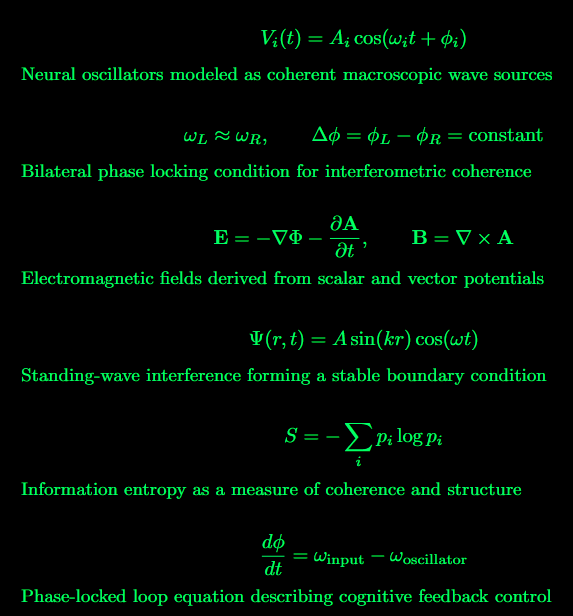
This composite equation plate summarizes the mathematical structures that parallel the neuro-scalar interferometric framework, including neural oscillators, phase locking, electromagnetic potentials, information entropy, and feedback control.